
Quick answer
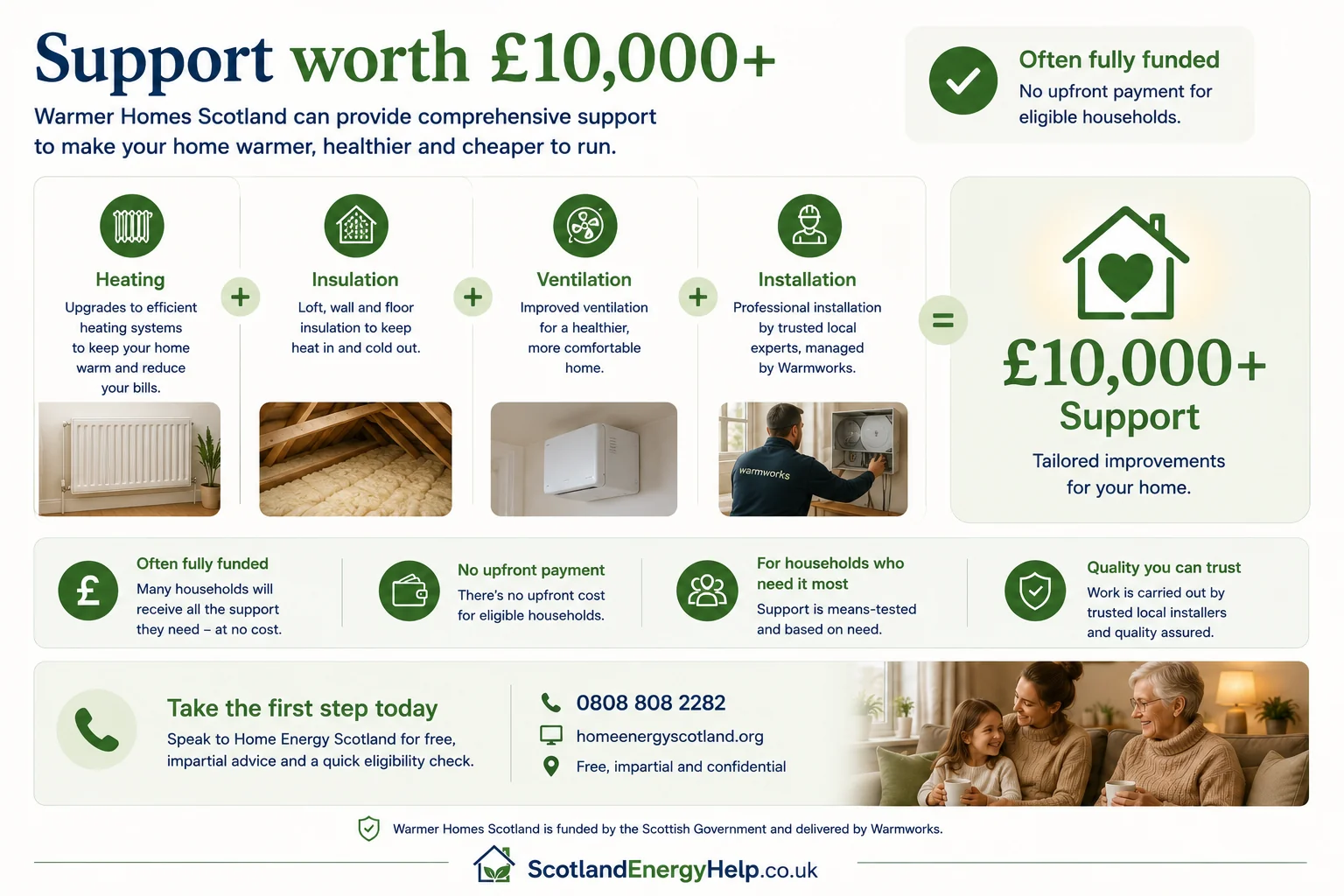
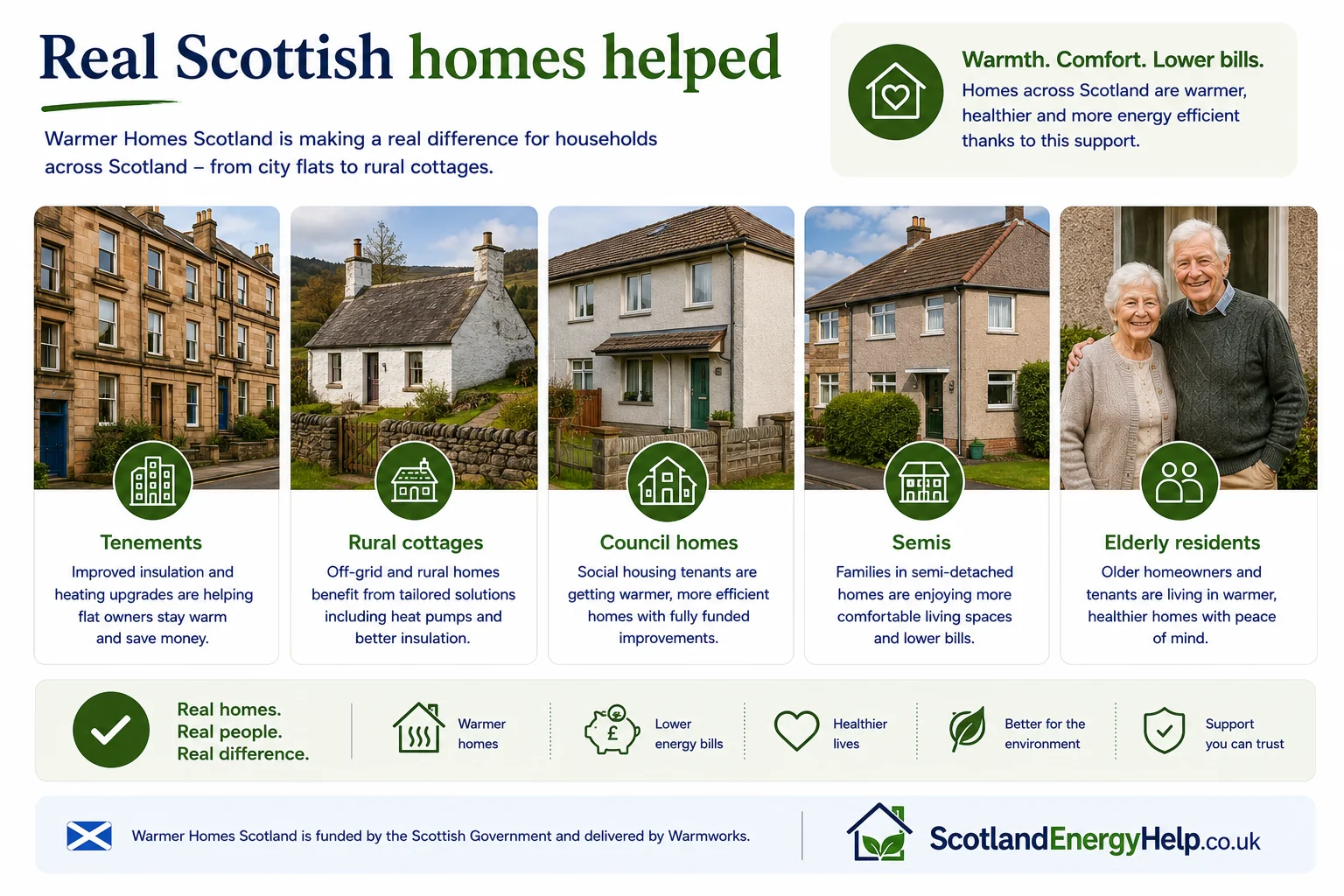
- Warmer Homes Scotland is the Scottish Government's national fuel poverty scheme. Eligible households receive £10,000 or more of home improvements — including heat pumps, insulation and new heating systems — at no cost.
- There is no £36,000 income test. Eligibility is based on receiving a qualifying benefit, being aged 75+ with no working heating, or holding a terminal illness certificate.
- To apply: call Home Energy Scotland free on 0808 808 2282 (Mon–Fri 8am–8pm, Sat 9am–5pm).
- 50,000+ Scottish households have already been helped since 2015.
What is Warmer Homes Scotland?
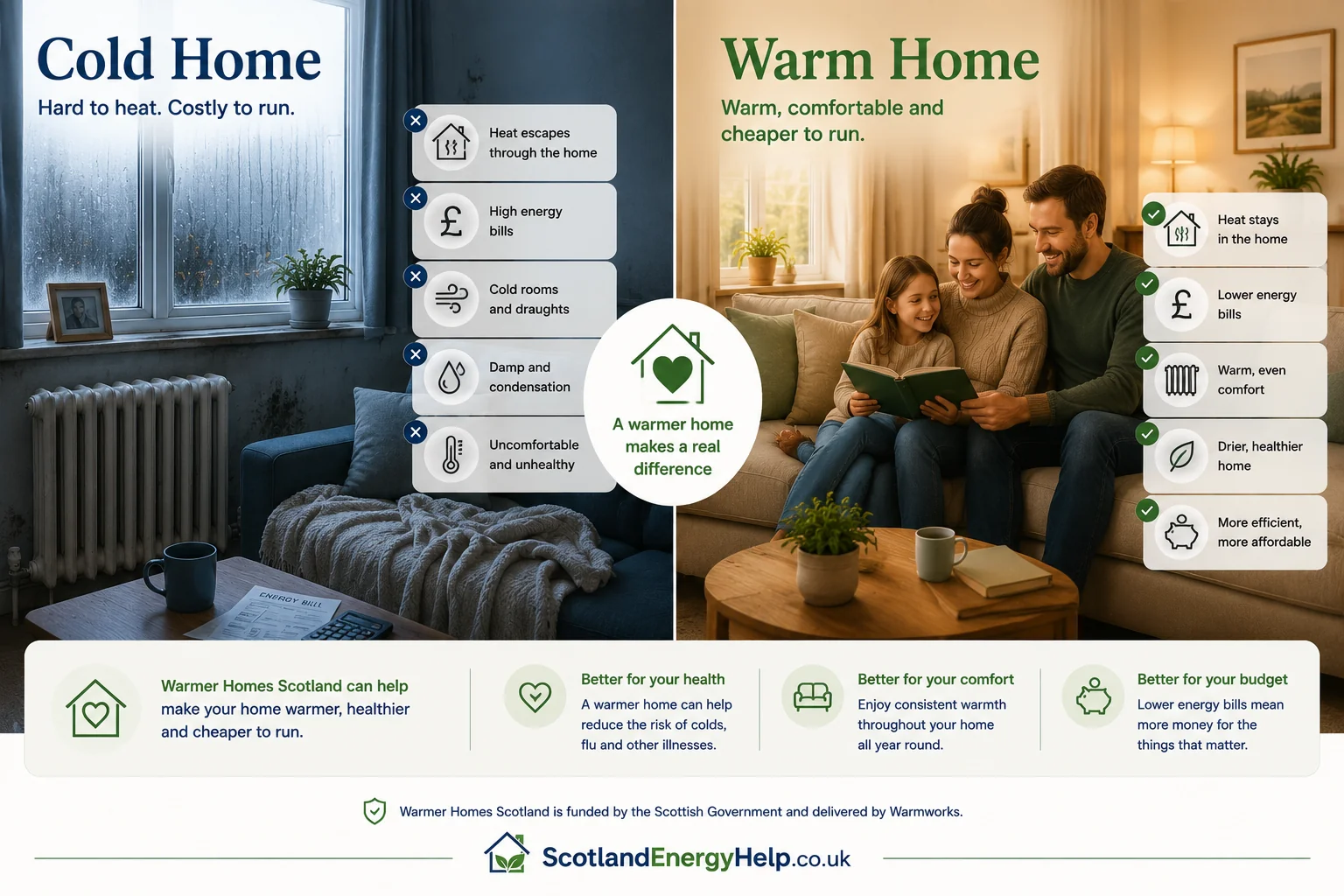
Warmer Homes Scotland is a Scottish Government-funded programme designed to tackle fuel poverty by paying for energy efficiency improvements in the homes of households who would otherwise struggle to afford them. It is the Scottish equivalent of the older Warm Front scheme south of the border — but fully devolved, with its own eligibility rules and its own delivery network.
The scheme is delivered by Warmworks Scotland, a managing-agent joint venture between Energy Saving Trust Enterprises, Changeworks Resources for Life and Everwarm Limited. Warmworks coordinates surveyors and a network of approved local installers across all of Scotland's local authority areas, from the Borders to Shetland.
All enquiries go through Home Energy Scotland on 0808 808 2282. This is the only legitimate application route — no installer, energy supplier or lead-generation website can apply on your behalf, and any cold call or doorstep visit claiming otherwise should be treated as a scam.
In February 2026 the scheme passed its 50,000th household milestone, with around £400 million invested since 2015. In 2024-25 it had its strongest year on record: 7,334 households supported, average annual bill savings of £466, 1,976 clean-heat technologies installed, and an estimated 5,900 tonnes of CO₂ saved. The scheme currently operates under Phase 2, launched on 2 October 2023.
Do you qualify? The eligibility criteria explained
The £36,000 myth
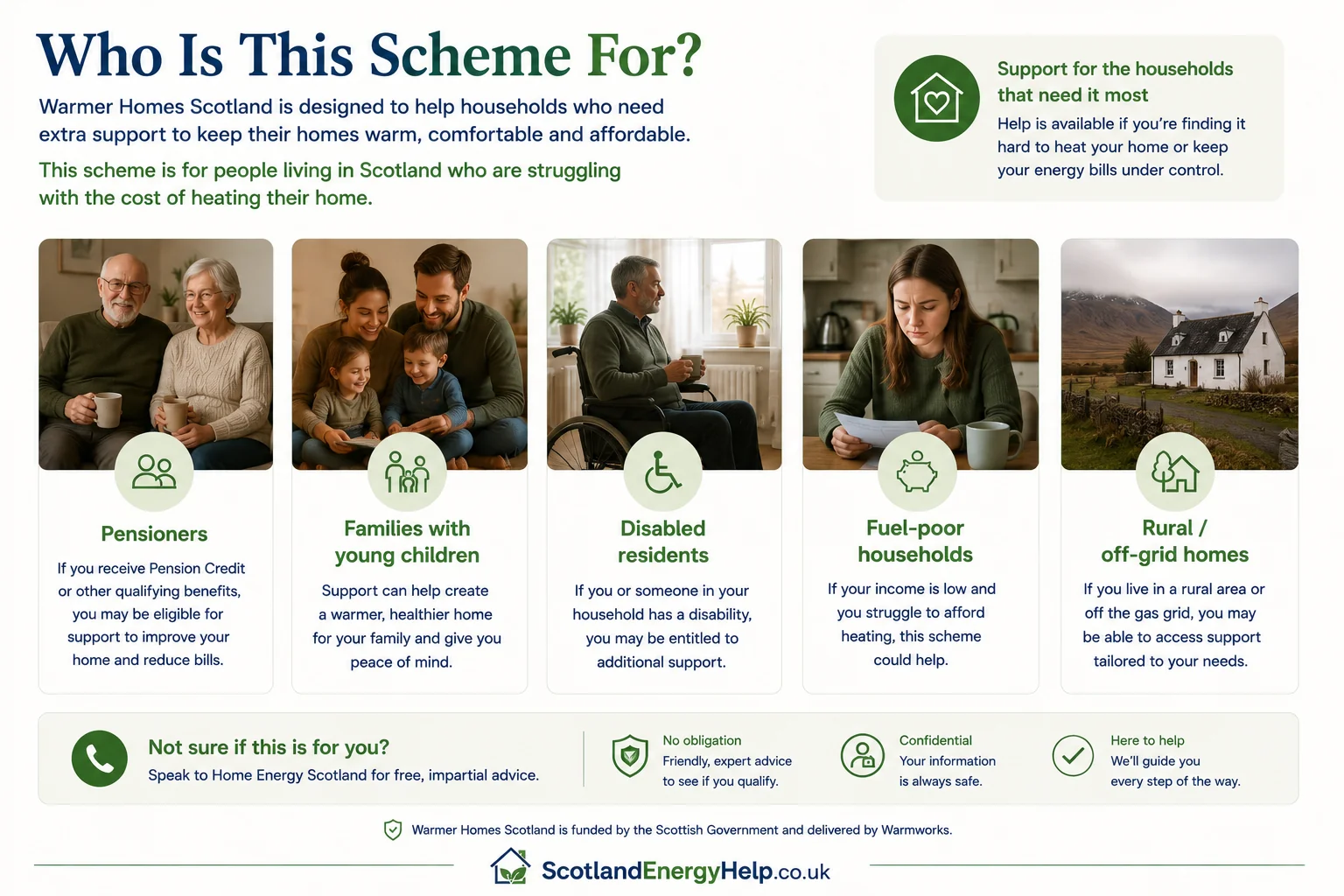
The official eligibility criteria from homeenergyscotland.co.uk and mygov.scot are as follows.
You must meet all of these property conditions
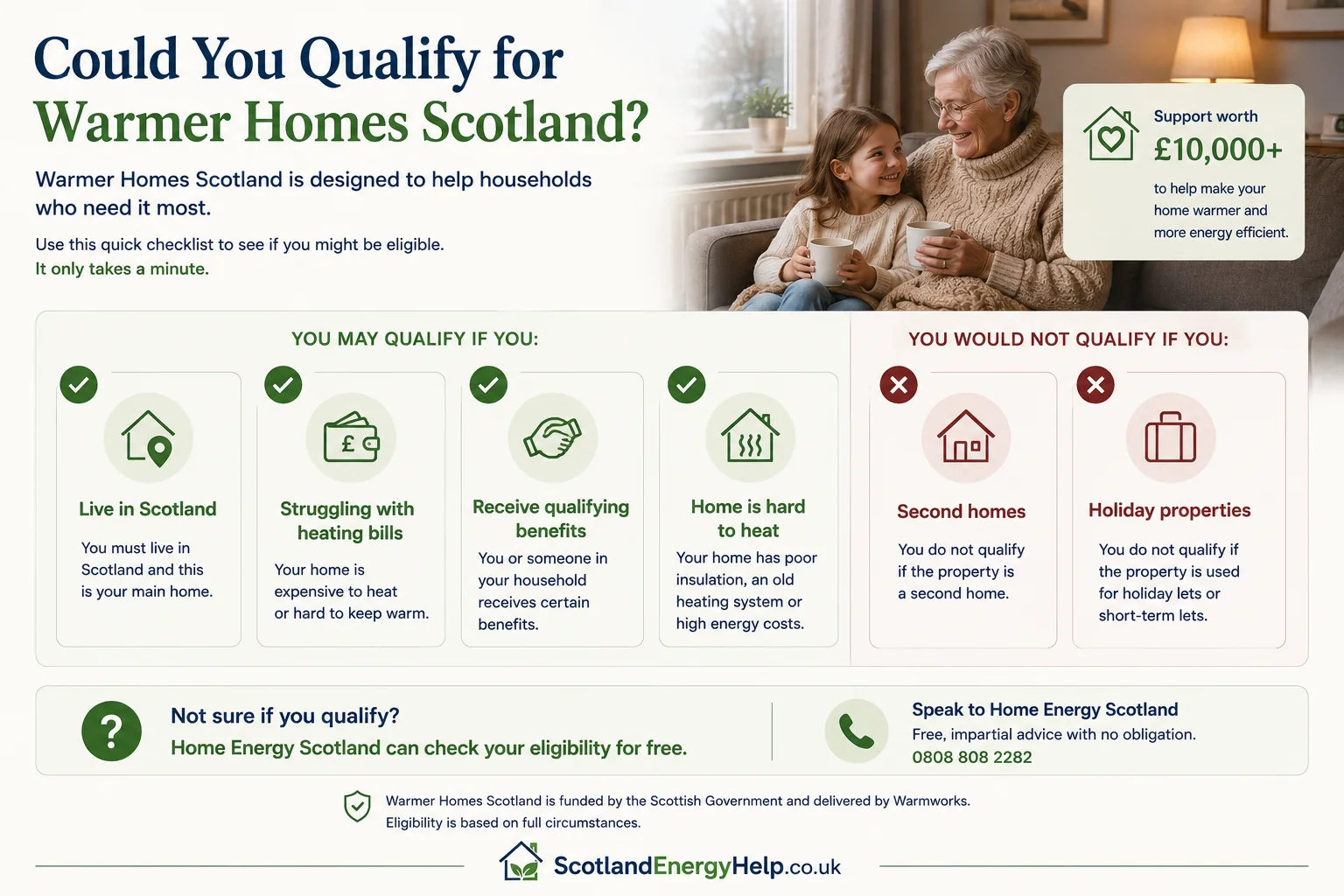
- Located in Scotland and used as your main home
- You are the homeowner or a private-sector tenant
- You have lived there for at least 6 months (waived if terminally ill)
- Council tax band A–G
- Floor area of 230 m² or less
- The property has a poor energy rating (assessed free at survey)
AND at least one of these household conditions
- Aged 75 or over with no working heating system, OR
- Hold a DS1500, BASRiS or SR1 terminal illness certificate, OR
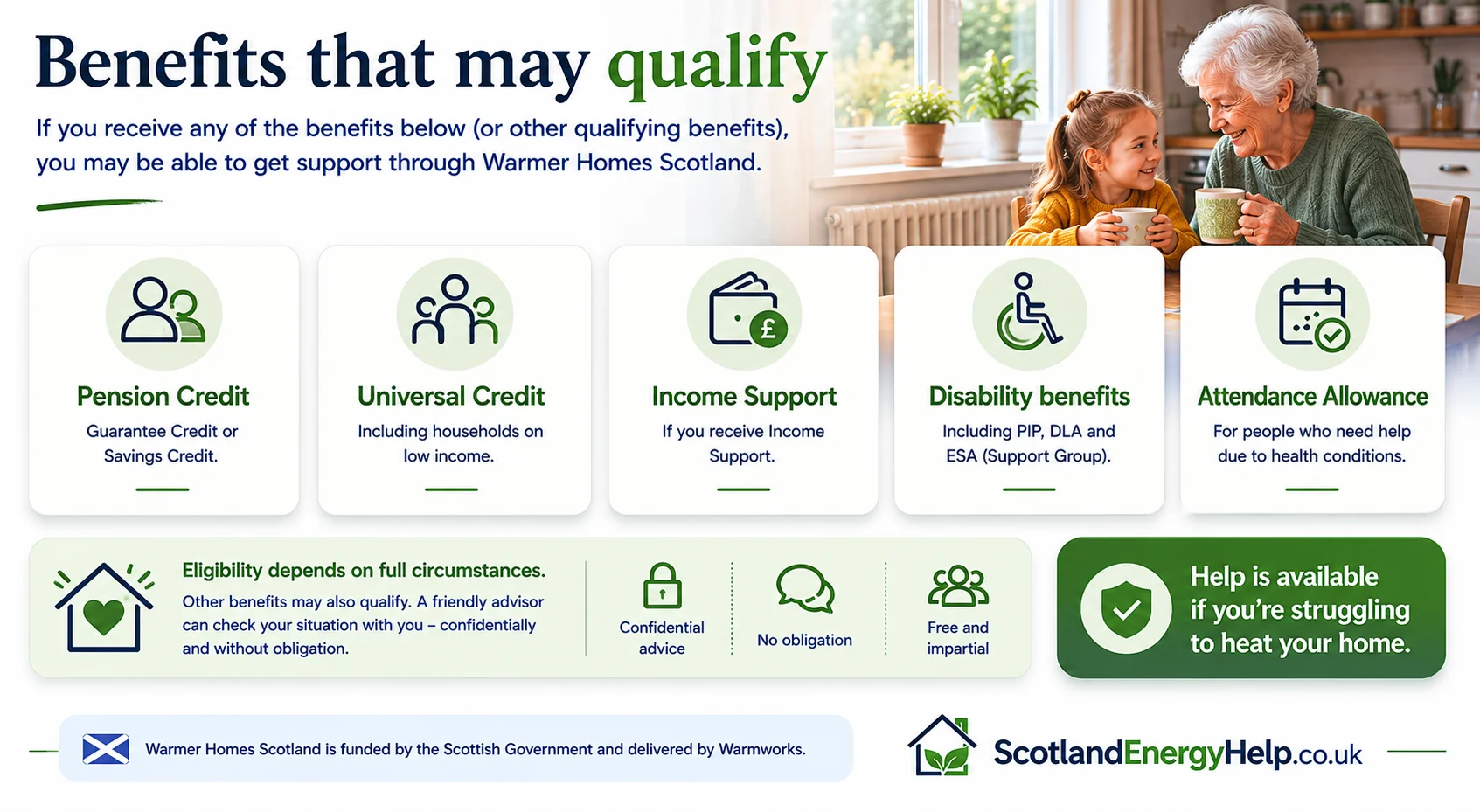
- Receive at least one of the following benefits: Adult Disability Payment, Armed Forces Independence Payment, Carer Support Payment, Constant Attendance Allowance, Council Tax Reduction (not the 25% single-person discount), Child Disability Payment, Housing Benefit, Income Support, Income-based JSA, Income-related ESA, Industrial Injuries Disablement Benefits, Pension Age Disability Payment, Pension Credit Guarantee, Scottish Adult Disability Living Allowance, Scottish Child Payment, Severe Disablement Allowance, Universal Credit, War Pensions Mobility Supplement.
Not eligible?
- Council or housing association tenants cannot apply directly — approach your landlord, who has separate funding routes.
- Landlords cannot apply directly under WHS — look at the Private Rented Sector Landlord Loan instead.
- If you don't receive any of the listed benefits and are not 75+ without heating, you will not qualify for WHS — but the Home Energy Scotland Grant and Loan offers up to £15,000 with no means test.
What improvements does Warmer Homes Scotland pay for?
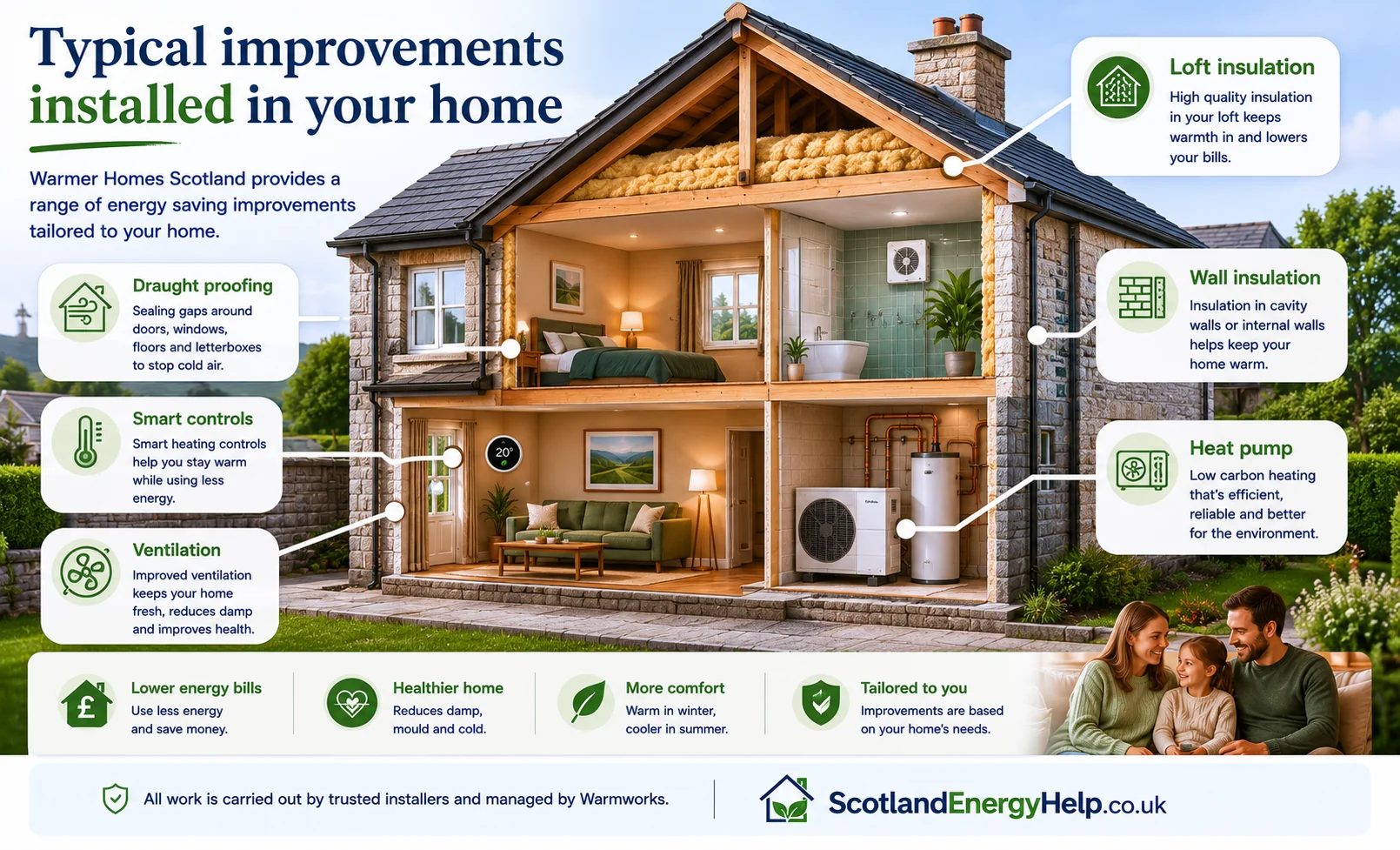
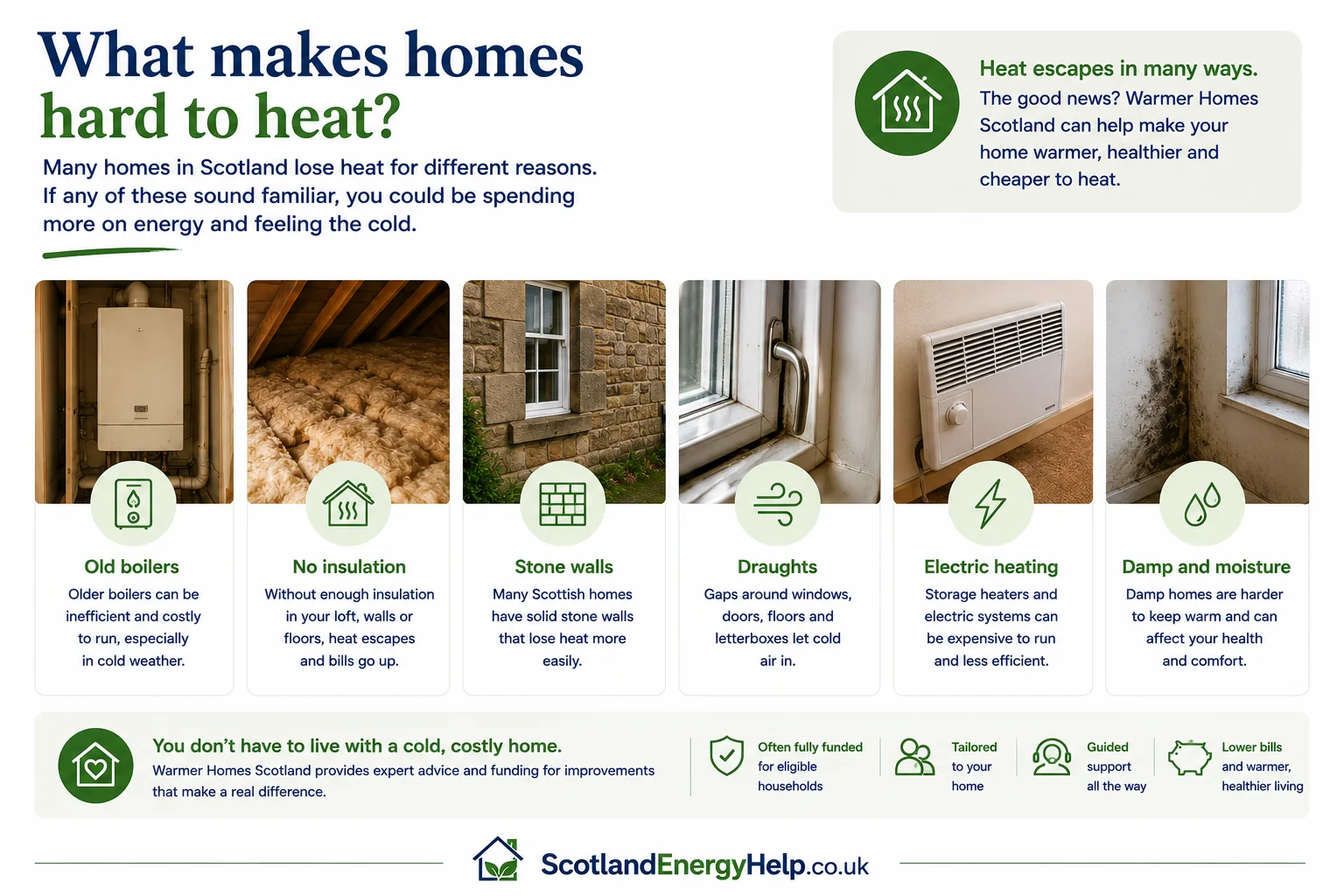
The scheme follows a whole-house approach: a surveyor assesses what your property needs, and Warmworks builds a tailored package rather than offering single isolated measures. The current list of eligible improvements reflects Scotland's clean-heat-first policy direction.
Usually funded in full
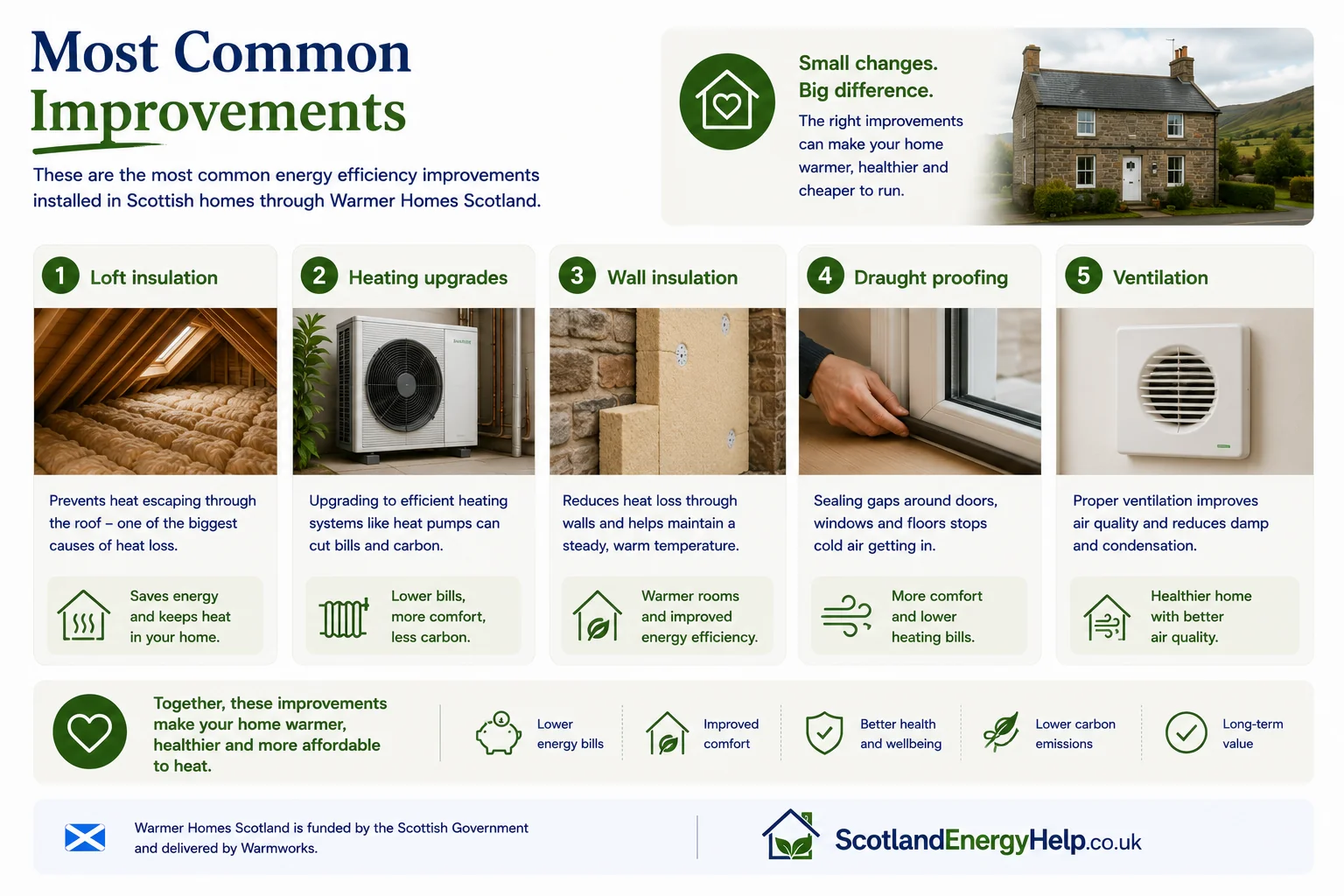
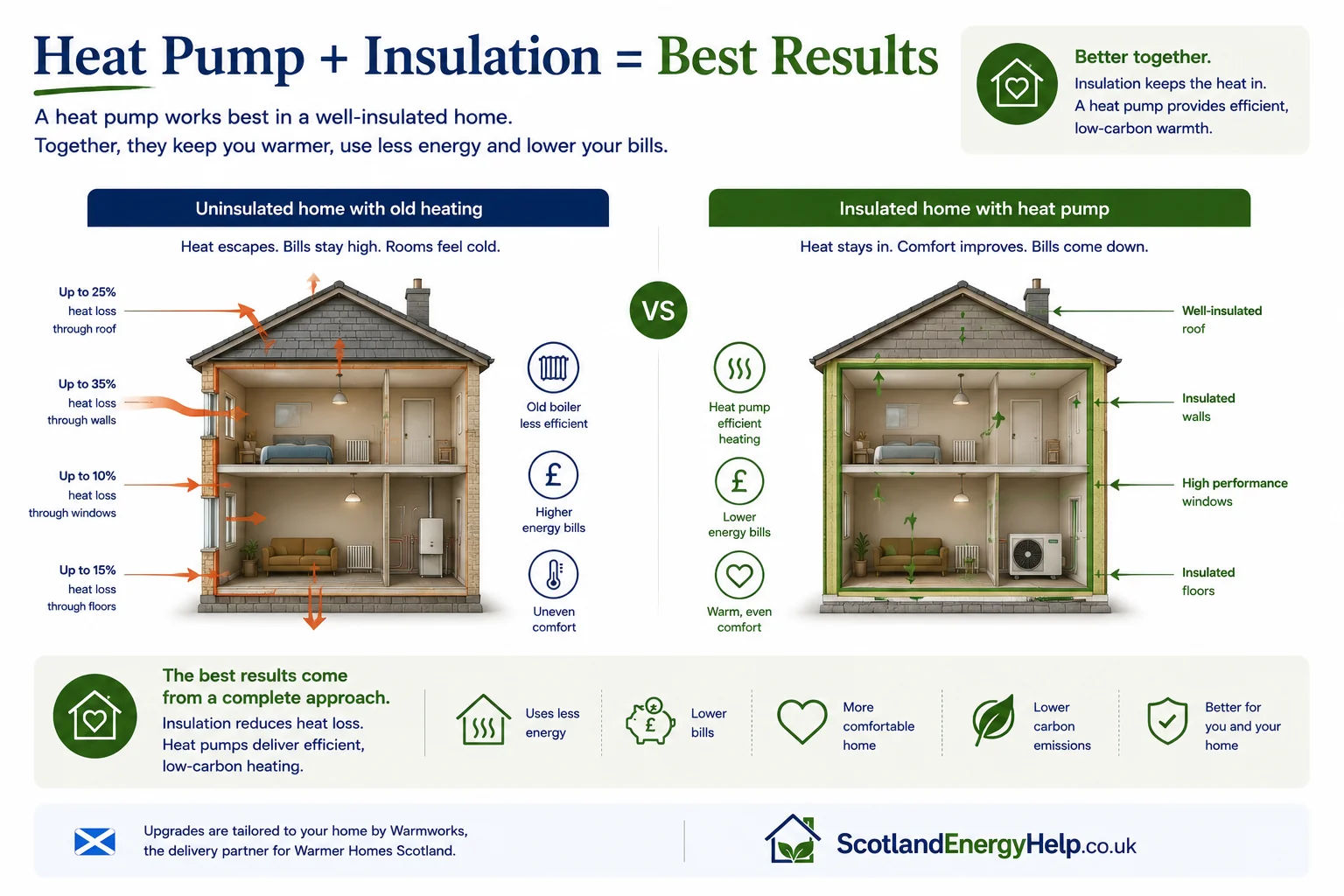
- Air source heat pumps (the preferred first option)
- Ground source heat pumps (for suitable rural properties)
- High-heat-retention electric storage heaters
- Loft insulation, cavity wall insulation, solid wall insulation (internal and external), underfloor insulation, room-in-roof insulation
- Draught-proofing, cylinder thermostats, heating controls, hot water tank jackets
- New gas boilers — only in rare cases where a heat pump would worsen fuel poverty; becoming increasingly uncommon
No longer funded
- Solar PV panels and battery storage (removed 2023–24)
- Hybrid heat pumps
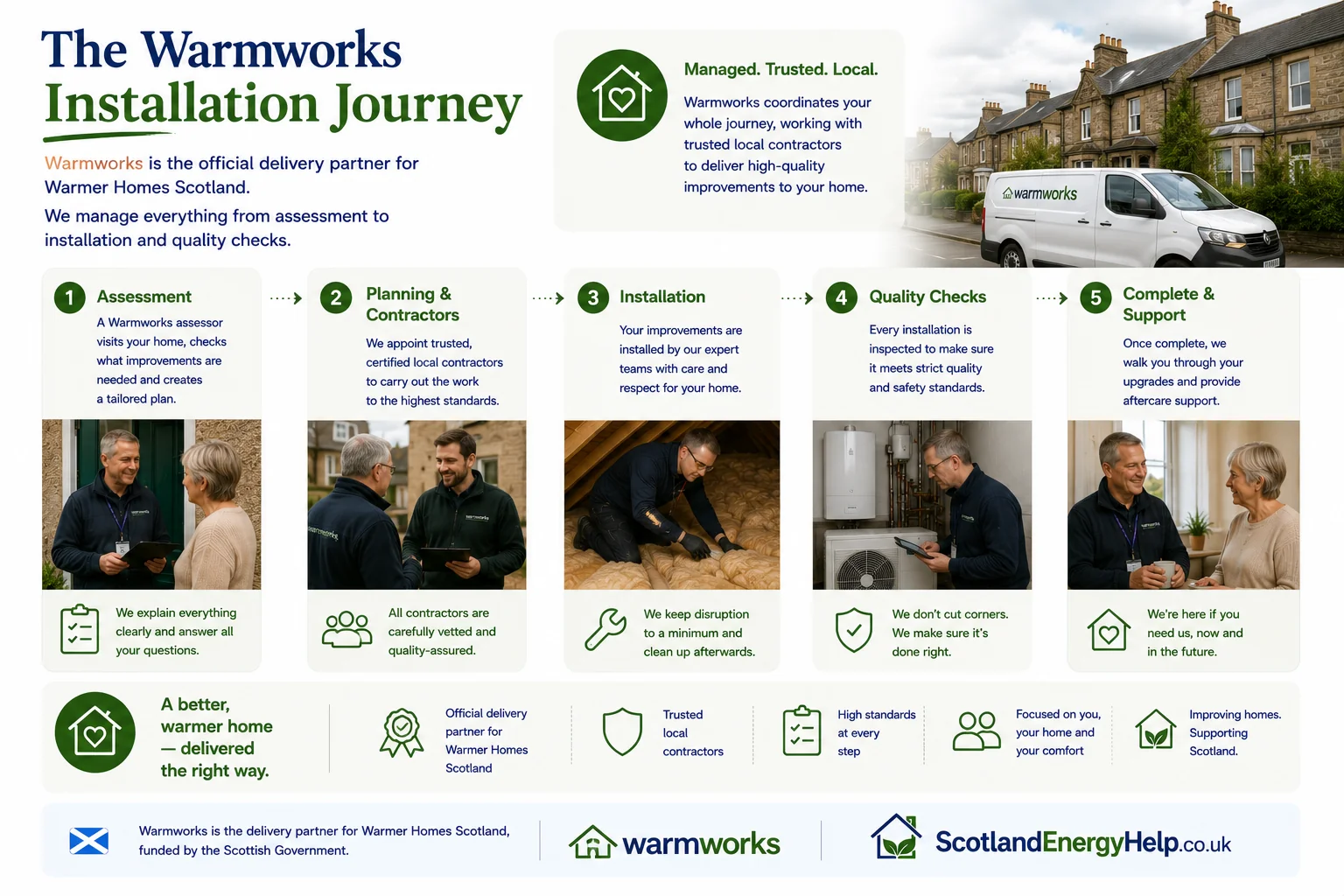
How to apply — the 7 steps
- Check your initial eligibility at the Home Energy Scotland online self-assessment tool at homeenergyscotland.co.uk, or call 0808 808 2282 directly.
- A Home Energy Scotland adviser runs a full eligibility check — you may need your council tax band, benefit award letter and an approximate floor area to hand.
- If eligible, Home Energy Scotland refers you to Warmworks Scotland within 2 working days.
- A Warmworks assessor visits your home (free of charge), inspects every room and your loft space, and verifies your eligibility. Bring benefit letters, payslips, bank statements or council tax bills as appropriate.
- Warmworks produces a tailored whole-house improvement package and confirms which measures will be installed.
- Warmworks-approved local installers carry out the work — the Scottish Government pays.
- An independent quality inspection takes place after installation to confirm the work meets standard.
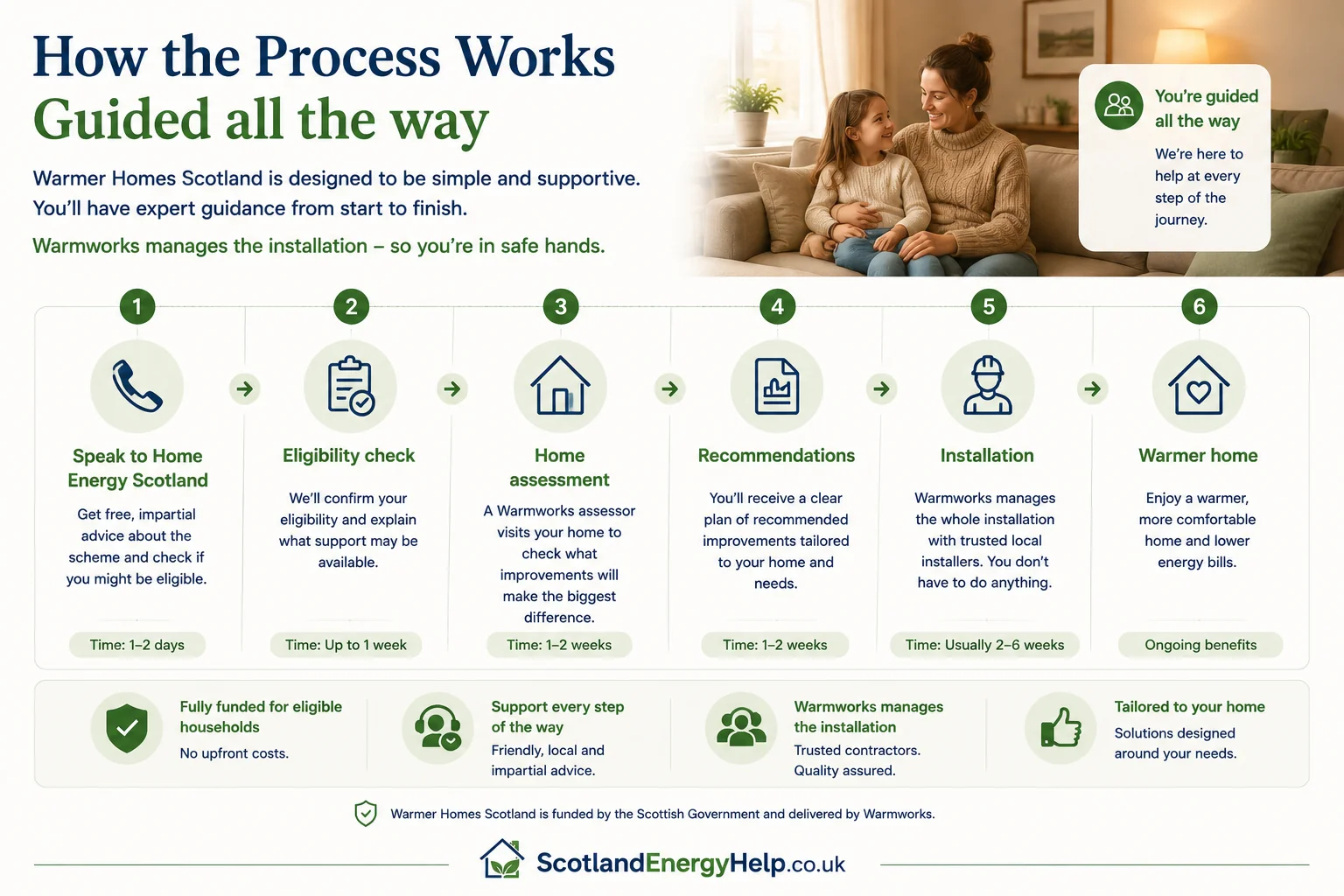
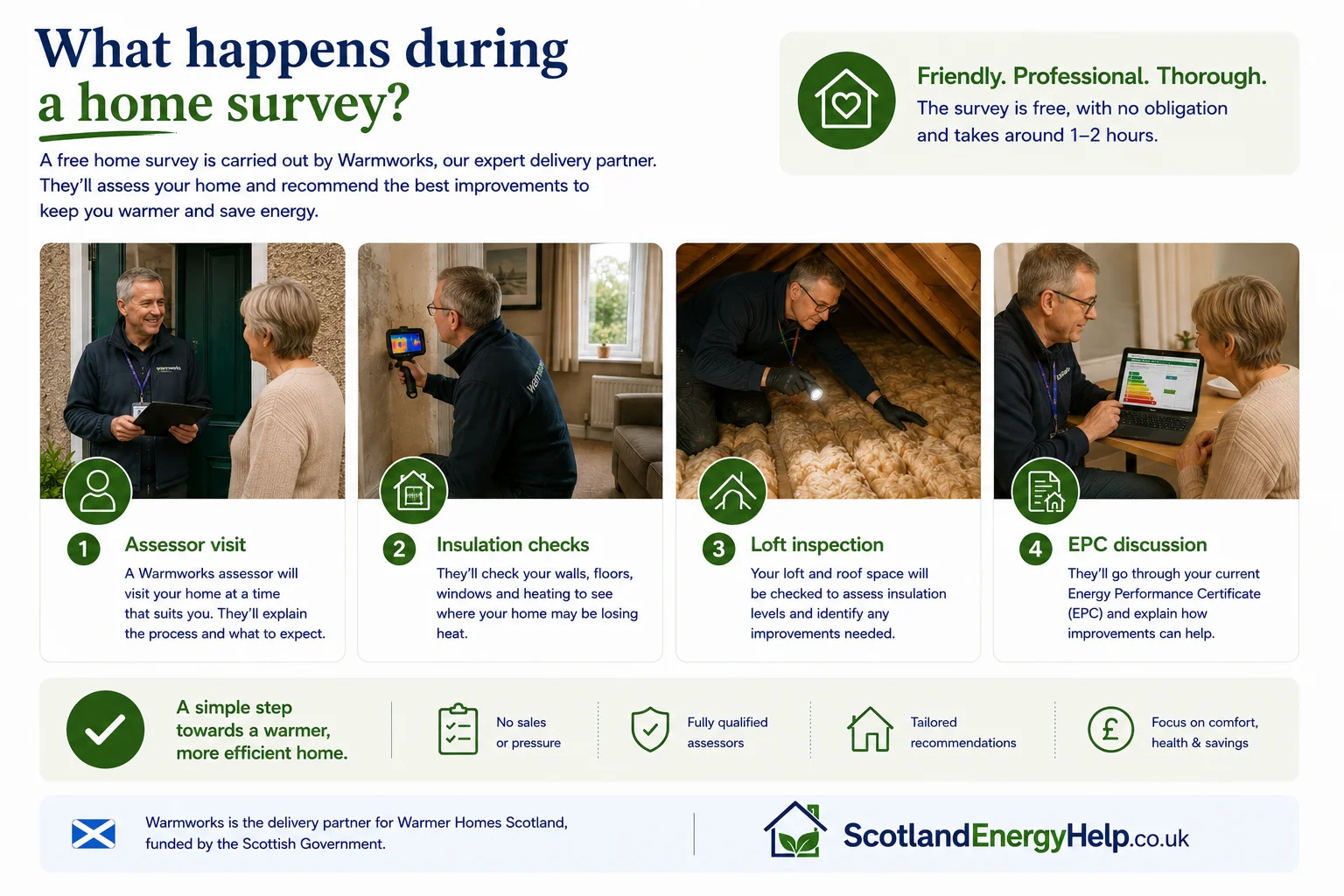
Insulation-only jobs can complete within weeks of referral; heat pump installs involving a full survey, design and commissioning typically take several months. Start the process as soon as possible — the scheme receives around 18,000 referrals per year and waiting times vary by region.
How does Warmer Homes Scotland compare to other schemes?
Warmer Homes Scotland is the most generous fully-funded scheme for households who meet its eligibility criteria, but it is not the only support available. If you don't qualify for WHS, another scheme almost certainly applies. The table below summarises the four main routes for Scottish households in 2026.
| Scheme | Best for | Funding type | Typical value | Means test? | Heat pumps? |
|---|---|---|---|---|---|
| Warmer Homes Scotland | Benefits recipients; 75+ no heating; terminal illness | Usually 100% free | £10,000+ | Benefit/age/health criteria (no income test) | Yes |
| Home Energy Scotland Grant & Loan | All owner-occupiers | Grant + interest-free loan | Up to £16,500 | No means test | Yes (£7,500 or £9,000 rural grant) |
| ECO4 | Benefits recipients off gas grid | Usually 100% free | Varies | Means-tested benefit | Yes |
| Area Based Schemes | Targeting by local authority | Free (area-based rollout) | Varies | Area-targeted | No (mainly insulation) |
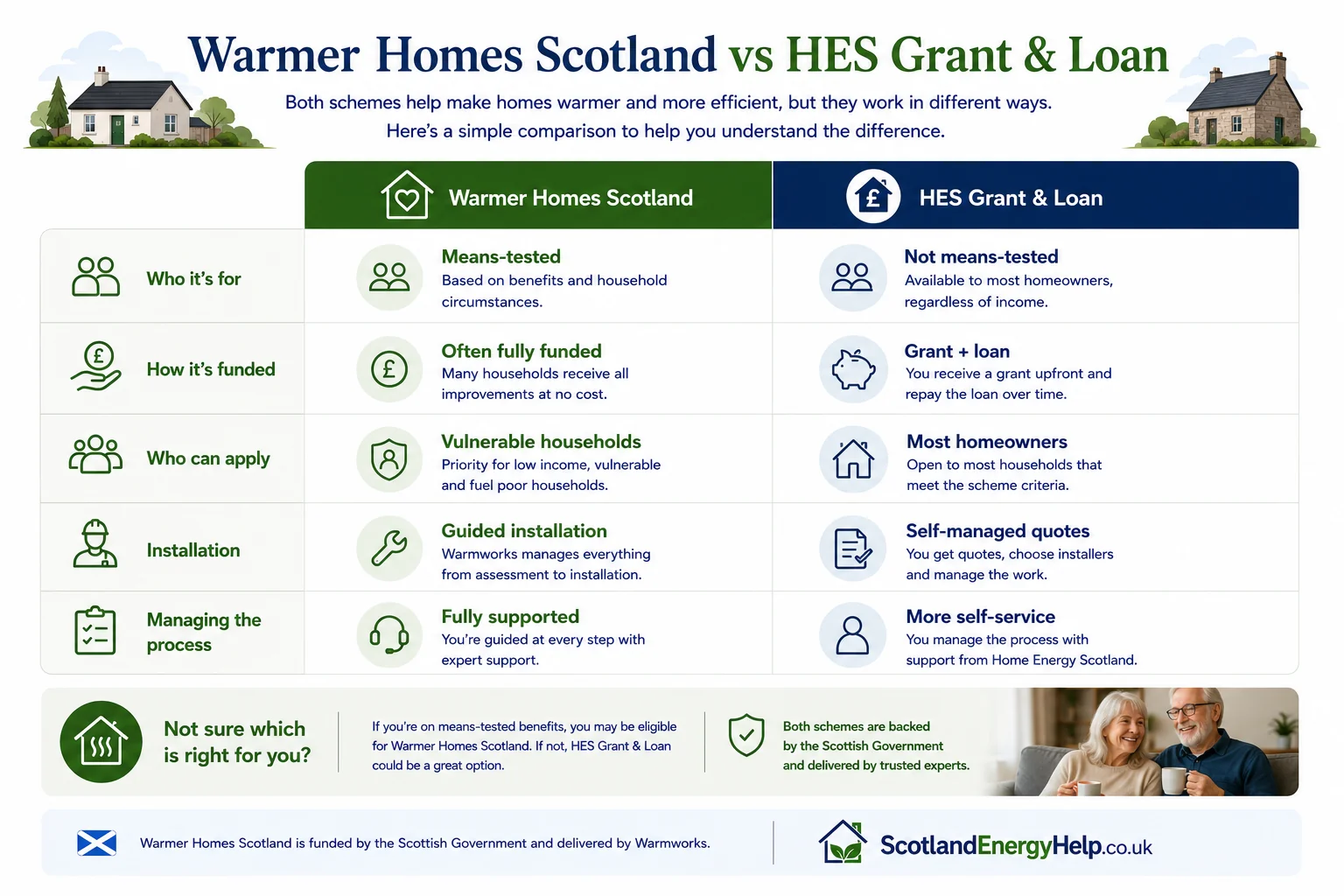
Not sure which applies to you? Our eligibility checker takes 2 minutes. It cross-references all four schemes — including ECO4 — and tells you which one you should apply for first.
The scheme in numbers
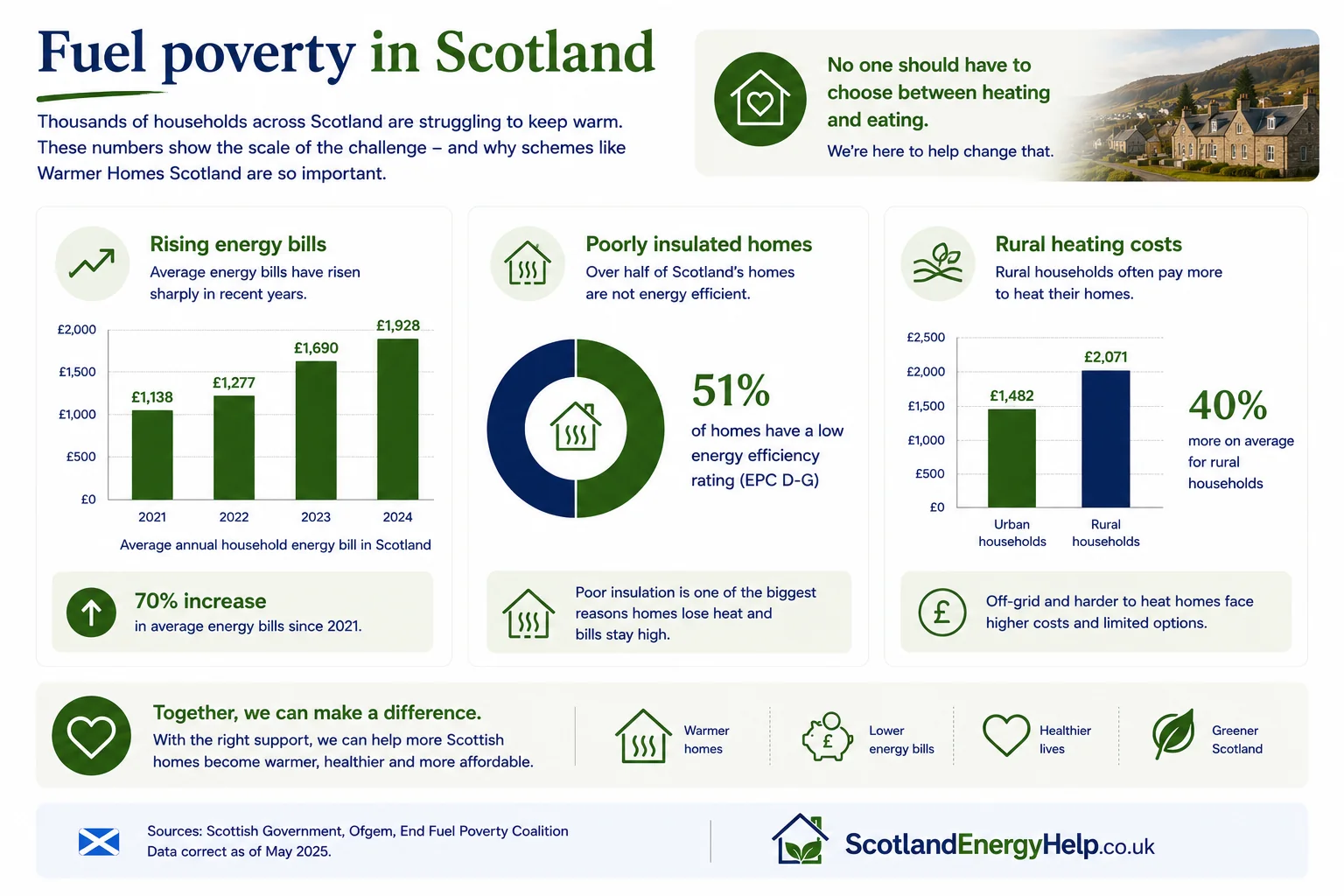
The figures below are drawn from official Scottish Government publications and the Warmworks Annual Report. They show both the scale of the programme and the gap it is working to close.
- 50,000+ households improved since 2015 — milestone reached February 2026 (Scottish Government, gov.scot, February 2026)
- Around £400 million invested by the Scottish Government since 2015 (gov.scot)
- 7,334 households supported in 2024-25 — a record year (Warmworks Annual Report, November 2025)
- £466 average annual fuel bill saving in 2024-25 (Warmworks Annual Report, November 2025)
- 1,976 renewable / clean-heat technologies installed in 2024-25 — a record (Warmworks Annual Report, November 2025)
- 5,900 tonnes of CO₂ saved in 2024-25 (Warmworks Annual Report, November 2025)
- 6.3 SAP points: average improvement in energy efficiency rating per home (Warmworks Annual Report, November 2025)
- 28.7% of Scottish households (around 732,000) were in fuel poverty in 2024, down from 33.9% the previous year (Scottish House Condition Survey 2024, gov.scot)
Common myths about Warmer Homes Scotland
1. "There's a £36,000 income limit"
False. This is an English criterion belonging to the Warm Homes: Local Grant and does not apply in Scotland. WHS eligibility uses benefit receipt, age and health criteria — there is no income threshold at all.
2. "You can get solar panels through the scheme"
No longer true. Solar PV and battery storage were removed in 2023–24 when the scheme moved into Phase 2. WHS now focuses funding on heat pumps and insulation.
3. "My energy supplier or an installer can apply on my behalf"
No. The only legitimate gateway is Home Energy Scotland on 0808 808 2282. Be wary of unsolicited calls, texts or doorstep visits offering "free Warmer Homes upgrades" — they are scams.
4. "The scheme ended in 2023"
It was paused briefly between 31 March and 2 October 2023 during the transition from Phase 1 to Phase 2. It has been running continuously since 2 October 2023 and celebrated 50,000 homes in February 2026.
5. "My landlord needs to apply for me"
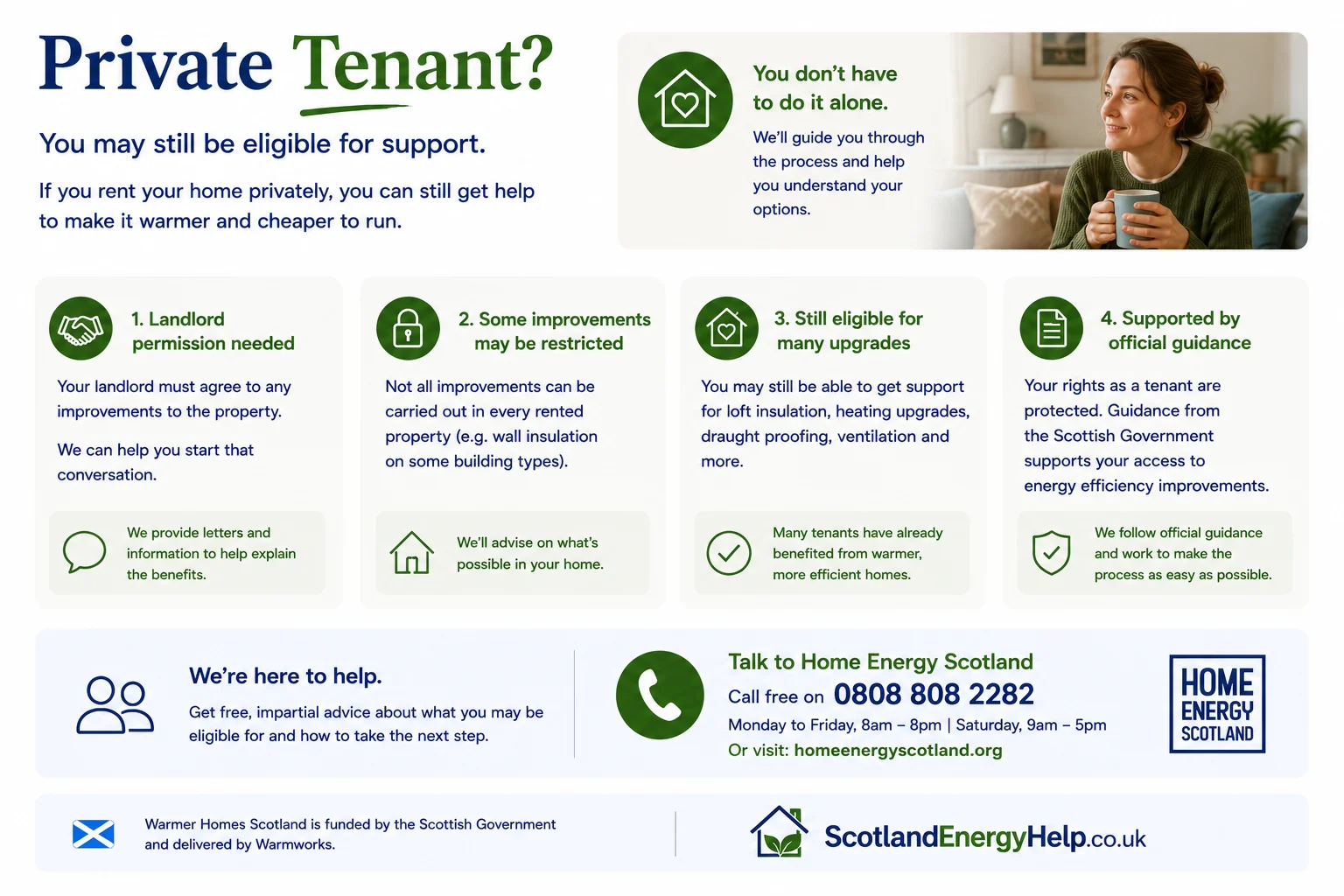
If you are a private-sector tenant who receives a qualifying benefit, you apply via Home Energy Scotland, not your landlord. Your landlord simply needs to give written consent for the works.
Frequently asked questions
Is there really no income limit for Warmer Homes Scotland?+
Correct — the official eligibility criteria from homeenergyscotland.co.uk and mygov.scot do not include an income threshold. Eligibility is based on receiving a qualifying benefit, being aged 75+ with no working heating, or holding a terminal illness certificate (DS1500/BASRiS/SR1).
Does Universal Credit qualify?+
Yes — Universal Credit is one of the passport benefits. You do not need to be receiving any particular element of UC; any amount qualifies.
Does Pension Credit Savings qualify?+
No — only Pension Credit Guarantee qualifies. Savings Credit alone does not.
Can I apply if I'm a private tenant?+
Yes, with your landlord's written consent. However, improvements your landlord is legally required to provide under the Repairing Standard will not be funded through WHS.
Can my landlord apply for my home?+
Landlords cannot apply directly under WHS. Private landlords should look at the Private Rented Sector Landlord Loan for funding options.
Will Warmer Homes Scotland pay for a heat pump?+
Yes — air source heat pumps are now the preferred first option wherever technically suitable. Ground source heat pumps are available for some rural properties.
Will I get a gas boiler through the scheme?+
Possibly, but rarely. The scheme now takes a clean-heat-first approach; gas boilers are only offered where a heat pump would not be technically or financially feasible without deepening fuel poverty.
Does the scheme still fund solar panels?+
No — solar PV and battery storage were removed from eligible measures during 2023–24 so funding could be concentrated on heat pumps and insulation.
How long does it take?+
Simple insulation jobs can complete within weeks of your referral. Heat pump installations typically take several months from assessment to commissioning. Call 0808 808 2282 to find out current waiting times in your area.
What if I don't qualify for Warmer Homes Scotland?+
The Home Energy Scotland Grant and Loan offers up to £7,500 grant + £7,500 interest-free loan for heat pumps and insulation — with no means test, open to all Scottish owner-occupiers regardless of income.
Still unsure? If WHS isn't right for you, read our guide to the Home Energy Scotland Grant and Loan — the main non-means-tested alternative.
What about the Heat in Buildings Bill?
On 18 November 2025 the Scottish Government published a draft Buildings (Heating and Energy Performance) and Heat Networks (Scotland) Bill, proposing minimum energy efficiency standards by 2033 and a phased end to polluting heating systems by 2045. As of May 2026 the Bill had not yet been introduced to Parliament; the Government said it would do so after the May 2026 Scottish Parliament election.
For WHS-eligible households this makes applying now especially worthwhile. Getting a heat pump or insulation funded free today means your home will already meet the proposed future standards — at no cost, and well before any compliance deadline applies. This is proposed legislation rather than current law, but the direction of travel is clear.
Find out in 2 minutes if you qualify
Check My Grants →